
The Role of the Guru
There is, somewhere in the scriptures of India, an image of a very large lake to which, every 5,000 years, a bird flies and carries off a single drop of water in its beak.
It is said that the length of time it takes for the bird to empty the lake does not even begin to describe the eternity of lives it takes for a human being to achieve his ultimate destiny, which is to become Self-realised, to establish his final oneness with God.
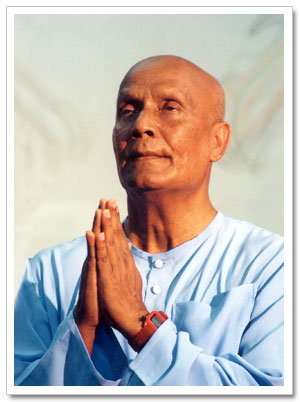 For many the thought of such an immense journey through endless cycles of suffering and experience is a depressing one – but there are two consoling comments to be made. For those who are consciously aspiring towards that final goal the lake is already almost empty, that long journey largely behind them; and then there is in each age and century a small number of guides who, having made the journey themselves, have come back to help us. They inspire us, remind us of our true destiny and purpose and awaken our longing and aspiration. This is the role of the Guru.
In the West there is often resistance to the idea of having a guru, but the presence in one's life of a living teacher is an immense opportunity and privilege. The guru accomplishes many things for us, accelerating our progress and shortening the time till our own realisation by many incarnations. Consider some of his or her functions:
Meditation
In accepting a disciple the guru undertakes the responsibility of leading that soul to God, and becomes one's 'eternity's friend'. My own guru Sri Chinmoy writes: "I wish to say that once you become a disciple and enter into my boat, then it is the problem of the boatman to take you to the golden shore. When I accept a disciple I concentrate on his soul and give the soul some inner meditation. I bring the soul forward and then the soul actually meditates in and through the seeker – in this way the disciple is bound to receive my inner instruction."
Every morning between 2am-6am this master meditates on all of his disciples around the world – guiding each one individually, specifically. "When I meditate on my disciples, I motivate and inspire each individual according to his acceptance of me and according to his capacity to receive and manifest the light that I am giving him."
Other masters of this century have also stressed the importance of meditation as the access bridge between themselves and their disciples, and stressed that no matter how far away physically they may be, they know their disciple's thoughts, feelings and consciousness. Referring to disciples in other parts of the world Sri Chinmoy writes that when a person concentrates on him, "immediately one of my inner beings or emanations comes to me and brings it to the attention of my physical mind. I may not know the name of the person, I may never have seen him in this life, but his soul comes to me and brings the face and physical form of the person right in front of me..."
And then further on: "Whether you are meditating in your master's physical presence or somewhere else is unimportant. No matter where you are, if you meditate soulfully you are bound to get his inner guidance. And this inner guidance, which is his inner oneness with you, will last forever and forever."
In this form of bhakti yoga the disciple meditates with his guru or on a photograph of his guru in order to tune in with that higher level of consciousness – this attunement is an essential part of discipleship. At the same time this attunement and devotion is impersonal, directed towards the guru's universal state of awareness and the qualities of that level of attainment rather than towards any human personality. When a God-realised spiritual Master enters into his highest consciousness, he is one with the Divinity within him. The human individual is entirely merged with God. To identify with this highest meditation of the master is to have a direct experience of the consciousness which is the goal of one's own inner search. This is not meditation on a human individual, but rather meditation on the Divine Consciousness, which is using the human as an instrument to reveal itself.
Acknowledging his role as a mere instrument, the guru steers devotion away from himself towards God – while in comprehending that God-Realisation actually means oneness with God, the disciple strives to please his Guru, for his guru's approval is therefore also God's approval.
Difficulties
 The acceleration that takes place in one's spiritual progress through the presence of the guru also means a karmic speeding-up, an intensification of all aspects of one's life – a cleansing, but sometimes difficult process whose benefits may await you beyond the limits of your current understanding.
My own extended visits with my guru, although occasions of great joy, have also precipitated all kinds of confrontations with the negative qualities inherent in human nature. These conflicts are an essential part of spiritual regeneration and their intensification offers an important opportunity to make rapid progress. The Guru has a catalytic effect in this way, for whatever negative characteristics we have repressed because they do not conform to our conscious ideal of ourselves, are surely and swiftly brought to our attention, to be faced and finally transcended.
The removal of these karmic fetters seems to be aided in many diverse ways by different masters – sometimes occultly or through physical contact or blessing; through food, even, or in the case of one master, Shirdi Sai Baba, by continuously handling small coins that his disciples had owned, extracting the negative condition from his devotees into himself. In India too, one sometimes sees devotees touching a guru's feet with their heads: in her biography of Meher Baba, Jean Adriel describes this as 'laying upon him the burden of their samskaras – those subtle impressions of thought, emotion and action, which bind the individual soul to recurrent earthly lives'.
Surrender and Obedience
For most Westerners surrender and obedience are two major stumbling blocks on the path of devotional yoga: to non-disciples the mere thought of an unconditional devotion to another person is abhorrent. We cherish our notion of freedom – even while knowing that our freedom is really only self-indulgence. But `real freedom `__ is something much higher, a freedom from suffering, attachment, ignorance and a life guided not by the pursuit of pleasure but by the very soul itself. And spiritual surrender, too, is not the surrender of a slave to the master, but a process of attunement with our own highest Self, our own Divinity, of which the guru is an outward representation. It is the human form which he must take that stands in the way of our recognition.
In relinquishing his own desires and cravings and surrendering his egoic self, the disciple is not surrendering to another limited finite ego, but to an embodiment of infinite truth, compassion and love, whose only motive is the disciples realisation. "I have to help you," Sri Chinmoy once said, "to serve mankind is the only reason I am here on earth." And so the master leads his disciples through ever deepening levels of understanding and love until finally, no trace of ego remains. "When the ego disappears", writes one teacher "there arises the knowledge of the True Self; one's consciousness is then that of the eternal and infinite 'I am,' in which there is no separateness, and which includes all life."
Progress
It is said that one incarnation spent with one's guru is equal to a multitude of incarnations of normal progress. His presence awakens our soul's longing for its creator so that all other worldly attachments are consumed in the wake of this one ascending urge to know God. The guru is the inspirer who reminds us of our real destiny, and who awakens the vast storehouse of energy and dedication that normally lies dormant within. As the agent of our transformation his call to perfection is drastic and uncompromising. He gives direction to this striving, kindling our aspiration again and again and pointing always to the farthest horizon. "Our goal," my teacher writes, "is always to go beyond, beyond, beyond. There are no limits to our capacity because we each have the infinite Divine within us."
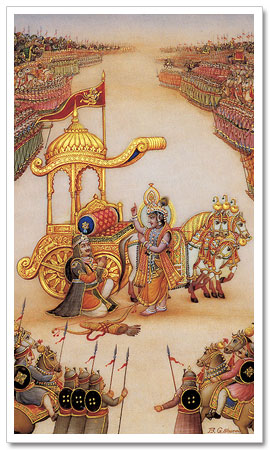 In each age the guru comes to make man aware of his divinity, to free man from his bondage and to lift him to a higher plane of being. The disciples effort in transcending and purifying his own nature is not confined to a passive and stoic endurance of challenges encountered with his guru, but extends actively into every area of his life – meditation, service, every aspect of his existence is his sadhana. He comes to welcome difficulties as a reflection of his own attachments or expectations, and learns not to cling, to let go of these parts of himself. He begins to realise that his life is really an extended workshop on God-Realisation, and that every hardship or problem simply presents him with another opportunity to achieve progress through surrender and desirelessness. His life becomes a meditation in action, increasingly centred in the consciousness that is growing within him. His guru's own compassion and detachment is taking root in his heart. This is the karma yoga of the Bhagavad Gita when Sri Krishna urges Arjuna to , 'Do what you do but dedicate the fruits of your action to me.' Sri Krishna's words to Arjuna are the words of every Realised spiritual master to his disciples and sum up the thrilling and immortal promise each guru makes...
Lord Krishna to Arjuna...
"Give Me your whole heart, sacrifice all for Me,
Bow to Me only, and you shall find Me.
This is My promise who loves you so dearly.
Give up then thy earthly duties,
Surrender thyself to Me only.
Do not be anxious;
I will absolve thee from all thy sin."
– from the Bhagavad Gita.
– Jogyata.

My God-Hunger-Cry - by Sri Chinmoy
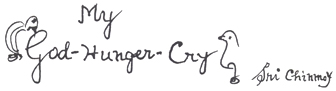
In October of 2005, Sri Chinmoy began a series of prayer-poems entitled My God-Hunger-Cry. We are delighted to feature them here and hope they bring you joy and inspiration.
My God-Hunger-Cry - by Sri Chinmoy
In October of 2005, Sri Chinmoy began a series of prayer-poems entitled My God-Hunger-Cry. We are delighted to feature them here and hope they bring you joy and inspiration.
China – Three Impressions
Impression One:
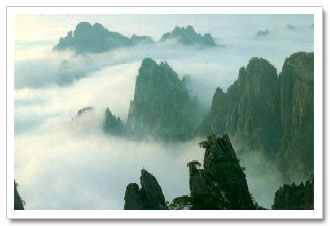 You are standing on the Yellow Mountains in eastern China, 6,000 feet up in the clouds, waiting in silence for the dawn. Around you a small group of your friends are dim figures in the mist, their breath forming white plumes in the cold air.
Huge feathery snowflakes are falling in slow motion like the softest down of giant geese, and you catch one in your outstretched palm to marvel at it's beauty. Below you on the steep mountainsides you have just climbed, giant bamboos bow under the weight of snow and the pines are Christmas trees of white, each needle a stalactite of crystalline beauty. You stamp your feet on the icy path and your cheap crampons grate on the granite slabs.
Now suddenly the mountain clouds are parting and there before you, materialising like phantoms from the mist, the fabled peaks and granite turrets painted down through the centuries in countless water colours and Chinese scrolls, rearing up into the dawn sky like so many lonely sentinels.
We were here to explore an ancient culture, twenty members from the New Zealand Sri Chinmoy Centre joining our international family and Sri Chinmoy himself on a six week visit to China. Bejing, Xian, Nanjing... Confucianism, Taoism, Buddhism. We would travel to many places and see many remarkable things. On the Great Wall near Bejing Sri Chinmoy would play the esraj in a spontaneous concert, the meditative sounds of this most haunting of musical instruments a perfect mirror of these endless jumbled hills and ancient landscapes.
Standing on those great ramparts, immersed in the silence of mountains and spirit of place, I was imagining the great armies of invasion and conquest marching across these remote wastes over the long sweep of centuries; marveling at the ambitions of the great rulers and Emperors and their dreams of dynasty. How perfectly Sri Chinmoy's music evoked these great struggles and sagas of our race.
In Qingdao in the half-light of dawn, we held running races two mornings of each week on the icy beachfront promenade above the freezing sea. In our function room later, Sri Chinmoy would personally award the fastest and often read out the times of all competitors, encouraging us not to grow old. Perfecting body and mind through running and meditation to better nourish the life of spirit. To realise God – the penultimate goal of all human life – every part of our being has to become surrendered and obedient to the divine task-master, the soul, the base metals of ignorance alchemising into the gold of a radiant Self.
And each morning, secluded in our function room like disciples or monks of old in their ashrams and temples, we would repeat the solemn and soulful prayer-chants of Sri Chinmoy, eyes half-closed in meditation. Here is a gem from Thursday, January 14, 2005:
O Lord Supreme,
Do dissolve me
Into Your Infinity's ecstasy.
O Lord Supreme,
Do dissolve me
Into Your Eternity's nothingness.
You can chant it slowly over and over as we did, like a Vedic mantra, or you can imagine you were there with us, hearing Sri Chinmoy deliver these lovely words with his unforgettable voice, a voice saturated in the consciousness of God.
Impression Two:
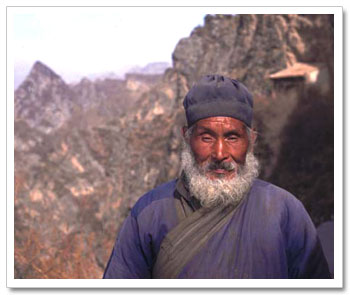 You catch the bus bound for Nanjing from the town of Huangshan, a six-hour ride that takes you at first through mountain passes and steep forested hills then out onto wide plains terraced with small fields and neat rows of crops. In the wintering fields, plastic bags flap on bamboo poles a poor man's scarecrow – and the pale green plains recede away into far-off silhouettes of mountains. You sketch a panda on your notepad and hand it to the old man across the aisle, pointing to the distant hills – are there any of those vanishing bears still left up there? – and he cackles with delight. His eyes twinkle and smile at you and looking into his face you know he is a survivor from a world you will never know or understand. Is he one of the old Taoist monks who took refuge in the mountains during the Revolution?
Now you are passing through ramshackle small towns where vegetable stands, bicycle shops, butchered animals and clothing spill out onto the footpaths and streets; onward through small villages where women wash clothes in brackish ponds and streams and dogs lie in the dust.
You doze and wake to find yourself at a dilapidated rest stop. Outside, the driver cradles a small puppy in his arms and the passengers crowd around him, clapping and smiling at his gentleness and taking turns posing for photos. The old Taoist stands alone, singing a song full of pathos, his eyes closed. He is free of all self-consciousness and dissembling and you envy him the depth of his feeling. Then onwards, south through fading light and industrial estates and fallow empty fields and far ahead in the growing darkness the lights of Nanjing are waiting for you, twinkling and pulsing like the heartbeat of this vastness land.
Like a lamp shining through a thin veil of cloth, the light of God shines through a realised Master, through every action, every moment of their life. They spread like a giant tree the pollen of enlightenment and if this pollen falls on you, your life will never be the same. Look at what happened to me this morning. At 6:30 am I was standing on the eighteenth floor of our hotel in Xian when the elevator door opened and there was Sri Chinmoy, standing alone in the lift. He beckoned to me without speaking and I joined him on the ride to the lobby. What is it about such an encounter that makes this so unforgettable? In the 20 seconds of our downward ride in the elevator, Sri Chinmoy simply looked at me smiling and meditating on my soul. Suddenly I felt breathless with the feeling of spirit, filled with light, elevated to another realm of being. My consciousness was catapulted upwards like a dove tossed into the sky to fly, and all day long a feeling of profound peace and stillness lingered inside me. How strongly I could feel my own soul! I could hardly speak and rushed back to my room to meditate. It is hard to describe such things. This is one of the things that a spiritual master can do for you in the twinkling of an eye.
Impression Three:
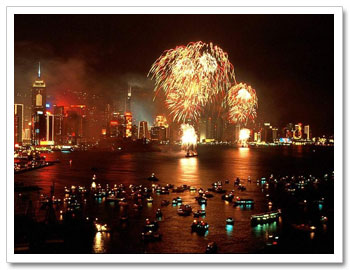 When you first hear the rolling thunder you stumble from your bed to the window and peer out into a midnight sky bright with splashes of colour and light. You go downstairs, out into the street, and the air is blue and pungent with smoke and fireworks are exploding across every part of the night sky, across the battlements of the old city wall and the high-rise apartment blocks, across the river that ferried troops at dawn during the wars and insurrections, across the downtown canyons with their skyscrapers and neon lights.
You think to yourself, why am I so comfortable here, why is it so familiar, have I been here before in some forgotten time and you turn away from the growing sounds of New Year revelry and the dancers in the hotel lobby draped in dragon costumes, leaping and swaying to the banging of drums and music and you walk along the nearly empty streets while the fireworks crackle in the alleys and explode over your head and all of your unlived lives are stirring inside you, all your secret longings squeeze your heart, and all your nostalgia for what you will never be and do tumbles down on your head like the spent casings of falling skyrockets.
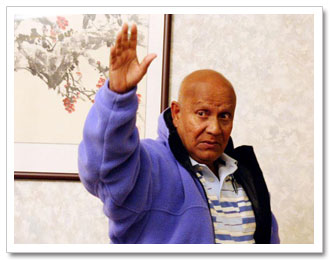 I remember well our last day in Nanjing. Those who have not already departed wait in the hotel lobby, spread out along the fifty metre route that Sri Chinmoy will walk from the elevator to the waiting van and the first leg of his long journey home. At 6:15 am he emerges from the lift, sees the gauntlet of his students awaiting him. He accepts this and begins walking very slowly, with tiny steps down the parallel lines, looking at every single person in turn for four or five seconds. "I hope I can see you all at least once in this incarnation," he had said of disciples living in far off countries, "so I can expedite your progress, your soul's journey." Many here come from such places – when will they see him again? – and this moment is intense and poignant. To each face Sri Chinmoy turns, smiling yet concentrated, a lingering, loving, farewell benediction, wordless yet powerful with the full force of an inner blessing. Yes, expediting the progress of the soul. Other hotel guests stand motionless, sensing that something sacred is taking place. In some part of their being they too will benefit from this encounter. The pollen of God, spreading to every heart and life. At the end of the line, Sri Chinmoy turns and waves one last time, not with a sense of goodbye but casually – to the Master there is no separation, time and space are creations of the mind, part real, part illusion. Then he steps into the van and is gone.
– Jogyata.
My God-Hunger-Cry - by Sri Chinmoy
In October of 2005, Sri Chinmoy began a series of prayer-poems entitled My God-Hunger-Cry. We are delighted to feature them here and hope they bring you joy and inspiration.
My God-Hunger-Cry - by Sri Chinmoy
In October of 2005, Sri Chinmoy began a series of prayer-poems entitled My God-Hunger-Cry. We are delighted to feature them here and hope they bring you joy and inspiration.
My God-Hunger-Cry - by Sri Chinmoy
In October of 2005, Sri Chinmoy began a series of prayer-poems entitled My God-Hunger-Cry. We are delighted to feature them here and hope they bring you joy and inspiration.
- ‹ previous
- 269 of 337
- next ›

Except where explicitly stated otherwise, the contents of this site are licensed under a Creative Commons Attribution-NonCommercial-NoDerivs 3.0 Unported License. read more »
SriChinmoyCentre.org is a Vasudeva Server project.